Gravel riding demands more from your equipment than any other discipline. When you are miles deep into a trail, a mechanical failure isn’t just an inconvenience—it’s a technical challenge that requires a “Maintenance Lab” mindset to solve.
Applying the standards of professional workshops, we have broken down the essential field repairs every rider must master.
Comparison: Home Lab vs. Trailside Tools
To perform these repairs effectively, your kit must meet professional tolerances.
| Tool | Essential Feature | Recommended for Trail |
|---|---|---|
| CECO-USA Multi-Tool | High-Tensile Steel (inc. T25 & Chain Breaker) | View on Amazon |
| CO2 Kit | Controlled Flow Valve | View on Amazon |
| Chain Tool | Hardened Steel Pin | View on Amazon |
The Pre-Ride Integrity Check (The “M-Check”)
The “M-Check” is a systematic safety inspection that follows the shape of the letter M, starting at the front hub and ending at the rear wheel.
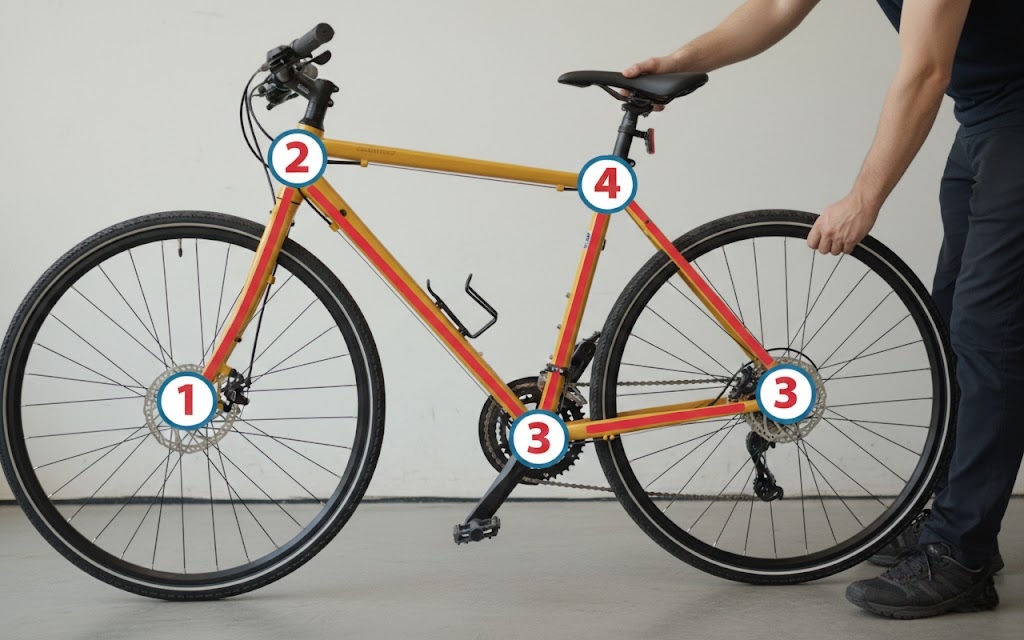
- 1. Front Wheel & Tire: Ensure the thru-axle is torqued to spec; check for lateral play in the hub bearings and inspect the tire sidewalls for “weeping” sealant or cuts.
- 2. Cockpit (Handlebars & Display): Perform a “twist test” to ensure the stem is securely clamped to the steerer tube. For E-Bikes, verify the display is secure and the firmware is clear of error codes before departure.
- 3. Brakes: Squeeze both levers firmly; they should not touch the bars. Inspect the calipers for pad wear and ensure the rotors are free of oil or contaminants.
- 4. Drivetrain & Cranks: Check the crank arm bolts for tightness (vital for gravel vibrations). Rotate the pedals to listen for “crunching” in the bottom bracket, which indicates failing bearings.
- 5. Saddle & Seatpost: Ensure the seatpost hasn’t slipped and the saddle rails are not showing signs of fatigue or cracking.
- 6. Rear Wheel, Chain & Gears: Inspect the chain with a wear indicator tool. Shift through the entire cassette range to ensure the indexing is crisp and the derailleur hanger isn’t bent.
Advanced Tire Recovery: Beyond the Plug
When a puncture is too large for sealant or a standard “bacon strip,” you need a secondary containment strategy.
- The Problem: A sidewall gash or a rim-strike “snakebite”.
- The Procedure: 1. Remove the tubeless valve nut and push the valve through. 2. Inspect the inside of the casing for debris. 3. Apply a Tire Boot (or an empty energy gel wrapper in an emergency) over the tear to provide structural support. 4. Install an inner tube and inflate to a lower-than-normal pressure to prevent the boot from shifting.
- Pro-Tip: Carry a valve core tool; sealant buildup often clogs valves, making mid-ride inflation impossible.
Drivetrain Surgery: The Chain Rescue
A snapped chain on a gravel climb is usually the result of shifting under too much load.
- The KitCrank Method:
- Extraction: Use your multi-tool’s chain breaker to remove the damaged outer link.
- Cleaning: Wipe the connecting ends to ensure the Quick-Link seats perfectly.
- Connection: Insert the Quick-Link (ensure the arrow points in the direction of chain travel).
- Tension: Rotate the drivetrain until the link is on the top row, then apply a sharp downward force on the pedal to lock it.
Brake Calibration & Rotor Truing
Disc brakes are prone to warping under extreme heat or accidental impact.
- The Diagnosis: If you hear a rhythmic “ping-ping” sound, your rotor is out of true.
- The Field Fix: 1. Look through the caliper to identify the point of contact. 2. Use a clean rag (avoiding skin oils) to gently pull the rotor away from the rubbing pad. 3. Critical Warning: Never use standard pliers; the serrated teeth will create burrs on the braking surface, causing permanent damage.
Post-Ride Lab Protocol
A trailside repair is a temporary fix. Once back at the lab:
- Replace any tires that required a boot or more than two plugs.
- Degrease and re-lubricate the chain, especially if it was handled with dirty hands.
- Re-Torque all bolts that were adjusted in the field.